To Us, the Model Generation: The World Doesn't Revolve Around Us / 给模型一代的我们:世界并不围着我们转
This past April, a friend in the fourth year of his PhD reached out to catch up. He had just landed a job, but because of a school policy he couldn’t graduate yet, so he was planning to go on leave and head straight to industry. I was surprised. Why couldn’t he wait another year, or even another six months?
He told me that when Opus 4.6 came out in February, coding agents made a qualitative leap. He had spent years honing his coding skills, and now the models were better at it than he was.
In the first half of this year, the PhD friends around me (myself included) all seemed anxious.
By the end of 2025, I no longer wanted to write papers. Then, in February 2026, a livestream in China about auto research left me unable to see any point in writing papers at all.
In May, a week before I left Meta, Meta went through a large round of layoffs. My collaborators were anxious at first, then relieved once they heard their org, MSL, wouldn’t be affected. I wondered: if you have to worry every day about whether you’ll be laid off, how can anyone do good work?
Maybe it was the overall mood at Meta, but back then I felt completely hopeless about the job market. Later I moved to Microsoft, and that hopelessness seemed to fade. At least I could feel that the people around me were happy, instead of worrying about when the next round of layoffs would come.
Another friend, a second-year PhD student, was struggling too. He turned down an internship at a hot startup, because he felt that going there would mean helping the company replace programmers. He used to love research, but whenever he thought that his research might directly put more people out of work, he felt terrible: “We’ll all be replaced by agents in the end anyway, so why should I care whether what I do means anything? I just want to do something I find interesting before I’m replaced.”
I could feel his pain, but human pain is not shared: mine came from not finding a job; his came from not finding meaning.
Another friend had already received an offer from a frontier lab but hadn’t started yet, and back then he was in as much pain as I was. We talked about how research in academia had become impossible and the paper system had collapsed; how the people who went to industry just a year before us had ridden the wave to material and professional success, while we, and those graduating after us, couldn’t see the road ahead. We all knew that knowledge and intelligence might no longer be useful, yet we couldn’t figure out what else we could do.
In the first half of 2026, agent capabilities exploded, and it felt like everyone fell into a collective anxiety. By July, the growing pains had passed; people gradually adapted to and accepted what agents could do, and the anxiety eased.
Other fields hit their growing pains somewhat later than we did. Over the past few months, models from OpenAI and Anthropic have solved one math problem after another that had stood unsolved for years. Mathematics has always been seen as the purest expression of human intelligence. If what was disrupted in the first half of the year was specific skills like coding and writing reports, what is being disrupted now is something close to intelligence itself. People have started to worry about mathematics and those who make a living from it: will mathematics as a discipline even survive?
After reading The Model Generation (《模型一代》), the essay that went viral last week, I realized that even though my friends and I have come through our growing pains, others may only be starting theirs. And everyone’s anxiety, like mine and my second-year friend’s, comes in two parts: not finding a job, and not finding meaning.
The anxiety of not finding a job comes from outside: there are fewer jobs, and finding one is harder. These things we can’t change. As a line often quoted in China goes, a speck of dust from the times, when it lands on one person, becomes a mountain. The younger generation can prepare in advance; the older generation has already ridden the dividends of the era to worldly success. Those of us caught in the middle (including people still doing PhDs or looking for jobs) can only accept things as they are, keep a more open mind, embrace more of life’s possibilities, adapt slowly, and wait out the growing pains. For this part, I don’t have a better answer.
The anxiety of not finding meaning, on the other hand, comes from ourselves, and I believe this part can be changed and resolved. Because intelligence is scarce, and because of the value it creates for human society, we have long held “human intelligence” in the highest regard. If you think of intelligence as a leaderboard, many people’s sense of their own worth, and the joy of “feeling that I matter to the world,” come from scoring higher than those around them on that leaderboard. Once others stop caring about the leaderboard, or once they are no longer among those at the top, anxiety sets in: without the leaderboard, they don’t know who they are or what they are worth.
If a person’s joy in doing something comes from “I can do it better than others” or “only I can do this,” then the arrival of AI is bound to take that joy away.
But not everyone is like this; some people do things out of love. Take mathematics. Did everyone who became a mathematician choose that career only to prove the world’s hardest problems, or because they believed they could rank near the top of that leaderboard? I think a large share of them chose it because they enjoy the process of solving, proving, and exploring: the rigor of mathematics and the beauty of its logic.
For the mathematicians who believed they might solve one of the world’s great problems in their lifetime, and made that their goal, AI may be a heavy professional blow. But for those who chose mathematics simply because they love it, does it really change anything? I think it does, but only in whether the profession can still support them, and that belongs to the external anxiety above. What it can’t touch is the joy they feel when proving a theorem.
So will mathematics survive as a discipline? As a profession people can make a living from, I don’t know. But as something that brings people joy, as long as there are people who enjoy the process of solving and proving, there will be people willing to pass it on, and it won’t disappear.
I believe geniuses come into this world with a mission, and they spend their lives changing it. But as someone who accepted my own mediocrity early on, I only need to live this one life well. Whether I exist or not, how I exist, whether I create value and what value I create: none of it will make much difference to the world.
Perhaps because I have no goal of changing the world, and I know clearly that I’m ordinary, apart from anxiety about employment I rarely get trapped by other anxieties anymore. It may not have been this way at first, but gradually my joy in doing something stopped coming from “I can do it better than others” or “only I can do this,” and came instead from enjoying the process itself. So when AI does better than me in my own field, it may make me worry about whether this profession will still exist (after all, people still need work to put food on the table), but it doesn’t take away the joy I find in the work.
AI can produce the results for us, but it can’t give us the joy of the process.

If you enjoy something for its results, AI may indeed hit you hard. If you enjoy the process, then as long as it isn’t directly tied to how you make a living, no matter how well AI does it, it won’t take away your enjoyment. If it does happen to be how you make a living, maybe try exploring other careers, and decouple what you enjoy from what pays your bills.
Likewise, if what makes you unique comes only from intellectual superiority, perhaps this is a chance to look for other things that make you unique. Even though AI can now prove the Riemann hypothesis, it still can’t guess why a person feels sad, or joyful, or calm, or why they cry.
I even think this is a good thing. This upheaval forces all of us to look for what makes us unique, to search inward for the spark that motivates us, to enjoy the process rather than the result, and to stop letting external leaderboards lead us through our whole lives. If, in the future, everyone who studies mathematics is someone who truly loves it, isn’t that a stroke of luck for the field?
Perhaps we can also take this chance to give a little more of our time and attention to things beyond work: to think more about our lives, about life itself, and about how we live, and about the possibilities beyond the path we were set on. We used to follow the script, believing that education could change our fate and that studying hard would get us a good job. If one day that assumption stops holding, and no one ahead of us can tell us which way to go, will we have the courage to play this game of life?
Lately, when I take taxis, I often strike up conversations with the drivers. Most of them aren’t local. In their twenties, they left their hometowns and families for an unfamiliar place, perhaps with nothing at first but one or two friends, and over ten or twenty years of hard work, they pieced together a life in a city far from home. What a brave thing that is.
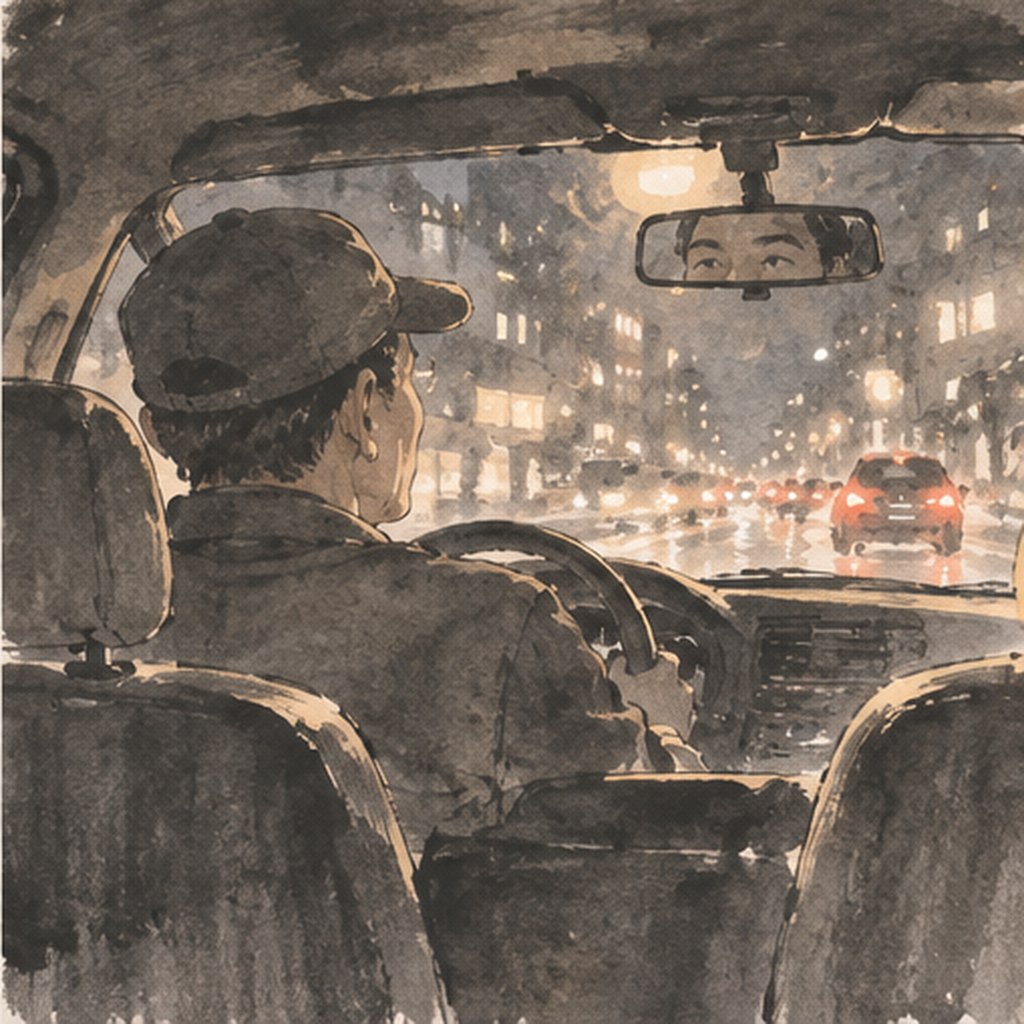
One told me he had tried many jobs: a cook in a restaurant, a baker in a cake shop, a garment worker in a factory. Another told me about the ups and downs of the past decade or so: running businesses, a supermarket and a massage parlor, investing in an amusement park and a bubble tea shop, through one success and failure after another. And there was one older driver who had also run businesses that kept growing, selling medicine and opening a hotpot restaurant, until COVID forced the restaurant to close and he lost everything he had made (the restaurant was huge). I asked him: if you saw a new opportunity later, would you put all your money into a business again? “Of course,” he said. I asked whether AI had affected him at all. He said no. And self-driving cars? “That’s still five years away,” he said. “By then there’ll be new opportunities.”
There is also a friend of mine who isn’t entirely in tech. He has done primary-market investing, worked as a product manager, interned at many places, and wants to start his own company. Every so often he messages me to talk through the new career paths he’s exploring. In these people, I see a vitality I can’t find in the ivory tower of our industry. There are so many people and so many things in this world besides AI, researchers, and programmers; the world doesn’t revolve around us. Look at the bigger world, and let go of a little ego.
Not every dinner table and bar is like the ones in the Bay Area and Beijing, where people talk about AI and LLMs every waking moment.